What Is a Friar? A Historical and Practical Explanation
The term “friar” is often misunderstood and frequently confused with other forms of religious life. While friars have played an important role in Christian history for centuries, their purpose, way of life and relationship to the broader community are not always clearly explained.
Text below provides a historical and practical explanation of what a friar is. It examines the origins of friars in the Middle Ages, the characteristics that define their way of life and how friars functioned within towns and cities. The focus is on understanding friars as they developed historically, with particular attention to Franciscan friars and the tradition that emerged from the life of St. Francis of Assisi.
What Is a Friar?
A friar is a member of a religious community formed for active service, preaching and engagement with the public. The word “friar” comes from the Latin frater, meaning “brother,” reflecting the communal nature of this form of religious life.
Historically, friars lived in community and followed a shared rule, but they were not confined to a single monastery. Their religious life involved movement between communities, interaction with the public, and work carried out in towns and cities. This outward-facing role distinguished friars from other religious groups that emphasized enclosure or separation from daily social life.
Friars committed themselves to a common way of life that included communal living, prayer and service. They supported themselves through a combination of work and alms, depending on the practices of their specific order. This approach allowed friars to remain closely connected to the communities they served.
Several religious orders fall under the category of friars, including the Franciscans, Dominicans, Carmelites and Augustinians. While each order has its own history and emphasis, they share the defining characteristics associated with friar life: community, mobility and public engagement.
Historical Origins of Friars
A friar is a member of a religious community formed for active service, preaching and engagement with the public. The word “friar” comes from the Latin frater, meaning “brother,” reflecting the communal nature of this form of religious life.
Historically, friars lived in community and followed a shared rule, but they were not confined to a single monastery. Their religious life involved movement between communities, interaction with the public, and work carried out in towns and cities. This outward-facing role distinguished friars from other religious groups that emphasized enclosure or separation from daily social life.
Friars committed themselves to a common way of life that included communal living, prayer and service. They supported themselves through a combination of work and alms, depending on the practices of their specific order. This approach allowed friars to remain closely connected to the communities they served.
Several religious orders fall under the category of friars, including the Franciscans, Dominicans, Carmelites and Augustinians. While each order has its own history and emphasis, they share the defining characteristics associated with friar life: community, mobility and public engagement.
How Friars Lived and Worked
Friars lived in small communities located within or near towns and cities. These residences, often called friaries, served as bases for communal life, prayer and coordination of daily activities. Unlike enclosed religious houses, friaries were integrated into urban settings and allowed friars to remain in close contact with the public.
Daily life for friars combined communal religious practice with active work outside the friary. Friars preached, taught, provided pastoral care and assisted people in need. Their work brought them into regular contact with merchants, laborers, families and individuals living at the margins of society.
Friars did not own personal property and lived according to rules that emphasized simplicity and shared resources. Depending on the order, they supported themselves through manual work, teaching or receiving alms. This economic structure allowed friars to remain flexible and responsive to local needs.
Movement was a defining feature of friar life. Friars traveled between communities to preach, study or assist where needed. This mobility supported communication between towns and helped spread religious ideas across regions, contributing to the influence of friar orders throughout medieval Europe.
Mendicant Life and Poverty
Friars are often described as mendicants, a term that refers to religious communities that relied, at least in part, on alms for support. In the medieval context, mendicant life did not imply constant destitution. It described a structured approach to communal living that avoided long-term ownership of property and emphasized dependence on daily provision.
Poverty, as practiced by friars, was understood as a communal discipline rather than an individual condition. Friars lived together, shared resources, and limited accumulation to what was necessary for daily life. This approach distinguished mendicant orders from religious communities that held land or generated income through agriculture.
Mendicant life allowed friars to remain active within cities. Without permanent landholdings, friars could establish residences in urban areas and respond to local needs. Their reliance on alms also created direct interaction with the communities they served, reinforcing their presence within everyday social life.
The mendicant model supported flexibility and movement. Friars could travel to preach, study or assist other communities without the obligations tied to fixed estates. This structure contributed to the rapid expansion of friar orders and their influence across medieval Europe.
Franciscan Friars as an Example
Franciscan friars provide a clear example of how friar life developed in practice. The Franciscan movement emerged in the early thirteenth century through the leadership of Francis of Assisi, whose approach to religious life emphasized simplicity, communal living and active service.
Franciscan friars lived in community and followed a shared rule that outlined expectations for prayer, work and conduct. Their daily life combined religious practice with preaching and service carried out among the public. This model placed Franciscan friars firmly within towns and cities, where they interacted regularly with local populations.
The Franciscan approach reflected key features common to friar life more broadly. Like other friars, Franciscans relied on shared resources, limited personal ownership and mobility to support their work. Their presence in urban settings allowed them to address social and religious needs that were prominent in medieval society.
Over time, Franciscan friars became one of the most widespread friar orders in Europe. Their example helps clarify how the friar way of life functioned historically and why it became an enduring form of religious community.
How Friars Differ From Monks
Friars and monks are both members of religious communities, but their ways of life developed for different purposes.
Monastic communities traditionally centered their religious life around a stable location, often in rural settings. Monks typically lived within enclosed monasteries and focused on prayer, study and work carried out within the monastic community.
Friars, by contrast, were organized for active engagement beyond their residences. Their communities were located in or near towns, and their religious life included preaching, teaching and service among the public. Friars moved between communities as needed, allowing them to respond to social and religious needs within urban environments.
These differences reflect the historical contexts in which each form of religious life emerged. Monastic traditions developed in earlier periods with an emphasis on stability, while friars arose in response to the growth of cities and the demand for religious presence within everyday social life.
Friars Today
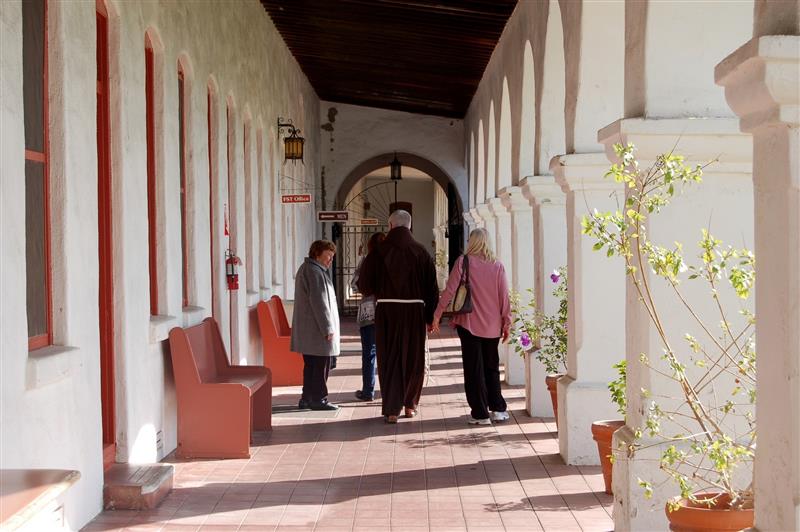
Friars continue to live in religious communities in many parts of the world. While their activities vary depending on location and order, friars remain committed to communal living, public engagement and service. Many friars work in education, pastoral care, social services and other forms of community involvement.
Contemporary friar life reflects both continuity and adaptation. While organizational structures and responsibilities have evolved over time, the defining characteristics of friar life (community, mobility, and engagement with society) remain consistent with their historical origins.
Friars and Mission History in California
Franciscan friars were the primary religious order involved in the establishment of the California mission system during the Spanish colonial period. Their presence reflected the continuation of Franciscan religious life in new historical and geographic contexts, shaped by colonial systems and local conditions.
At Mission San Luis Rey, Franciscan friars played a role in religious administration, record keeping and daily operations. Their activities were documented in mission records that provide insight into how friar life functioned within the mission system.
Learning More Through the Old Mission Museum
The Museum at Old Mission offers historical context related to Franciscan friars and the mission system in California. Exhibits and archival materials include objects, documents and interpretive displays that help explain how Franciscan religious life was organized and recorded.
Museum resources provide opportunities to examine how friars lived, worked and were represented in historical records. These materials support a broader understanding of the Franciscan tradition and its role in regional history.