The San Damiano Cross
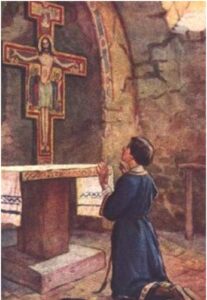
Early in his conversion, Francis of Assisi would pray in the small chapel of San Damiano, about halfway down the hill from the town. The sources tell us that one day he heard Christ speak to him from the cross, “Go, rebuild my church which is falling into ruin.” The San Damiano cross has become an important icon in the Franciscan tradition, and it is a rare Franciscan place that does not have a replica.

Painted about the year 1100 A.D. in a Syro-Byzantine icon style, it is 6 ft. 10 in. high and 4 ft. 3½ in. wide. The artist seems to have been particularly influenced by the Gospel of John. When the basilica of St. Clare was finished in 1257, the Poor Clare sisters, who had been living at San Damiano, moved there and brought the cross with them. It now hangs in a side chapel of St. Clare’s basilica.
Based on the relative sizes of the figures, we will begin with the large figure of Christ, then move to the mid-sized community under his arms, and finally, look at the small figures at the bottom, along the sides, and at the top of the cross.
Christ on the Cross
While each gospel mentions an inscription giving the charge of Jesus’ crucifixion, the cross reflects that of John (19:19), “Jesus of Nazareth, King of the Jews (Latin: Iesus Nazarenus Rex Iudeorum, the source of the familiar INRI abbreviation common on crucifixes).
Jesus’ face is covered by a halo (in front of his head, not behind it) which serves to darken it. In the Old Testament, to describe the awesome presence of God, the poetic image is sometimes used of a dark cloud with light inside of it (like a storm cloud with lightening); this was called “the glory of God.” An important theme in John is that in Christ we see the “glory of God,” (e.g. 1:14). Blood flows from the hands, feet, and side of Jesus. The blood from the feet drips down naturally, but that of his hands does not; it flows, on both sides, down to his elbows, and from there, down onto the group under his arms.
The garment is not a simple loin cloth, but an elegant white garment with gold trim. This is a priestly garment, known in the Old Testament as an ephod of white linen with gold trim (Exod 28.5).
We see Jesus as a king enthroned on the cross and as a priest who intercedes for his people. As the “glory of God” in our midst, Jesus looks out peacefully and serenely.

The Community under Jesus’ Arms
A community of nine persons are gathered under Jesus’ arms; the artist has supplied names for some of them. On the left are Mary and John (19:26-27), representing the new family of faith. On the right are Mary Magdalene and Mary, mother of James (Mk 15:40), and a man dressed as Roman, called the centurion. In Jn 4:46-54, a royal official asks Jesus to heal his son; Jesus does so, and “he himself believed, along with his whole household” (4:53).
On the right are Mary Magdalene and Mary, mother of James (Mk 15:40), and a man dressed as Roman, called the centurion. In Jn 4:46-54, a royal official asks Jesus to heal his son; Jesus does so, and “he himself believed, along with his whole household” (4:53).
Looking over the centurion’s shoulder is the face of a boy, behind whom are three foreheads representing the household. The new family of Christ includes Jew and Gentile, women and men, young and old, living in his light (behind them) and nourished by his blood (dripping from his arms and side).
Smaller Figures at the Bottom, Sides, and Top
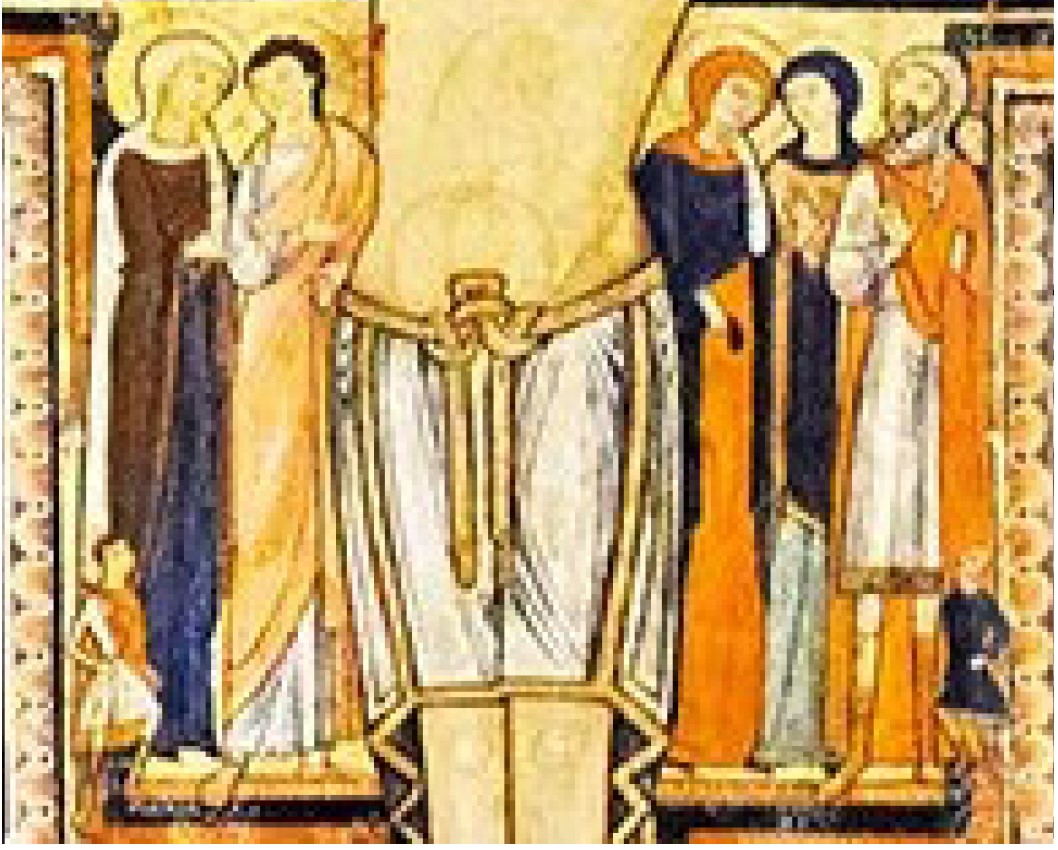
At the bottom is a scene that includes several people, but it has been so eroded over time that the rest remains uncertain; a guess will be offered below. About halfway up Jesus’ legs, on the right, is a rooster crowing, recalling Peter’s denial as the cock crows (Jn 18:27).

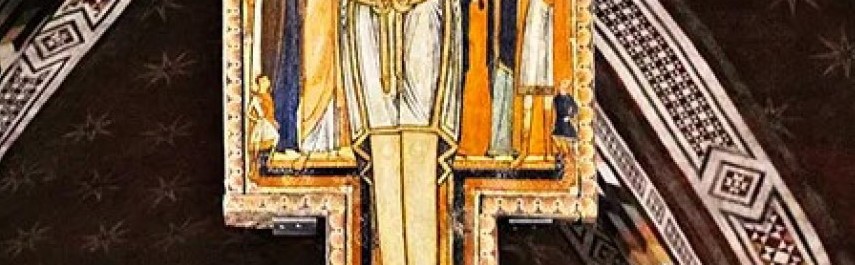
Further up are two small figures; on the left is a Roman soldier with spear identified as Longinus, who pierced the side of Christ (Jn 18:34). On the right, dressed very differently, is a figure representing those Jewish leaders who pushed for Jesus’ death. Thus, a Jew and Roman “look on the one whom they have pierced” (19:37).
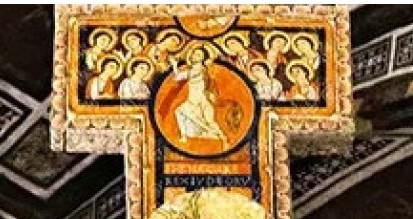
At the top, three pairs of angels point to the risen Christ, who ascends to the Father’s right hand, welcomed by 10 angels to the heavenly realm. Since these smaller figures take us through the passion, death, resurrection, and ascension of Christ, the bottom scene might begin this movement with a last supper scene (?).
The material in this article is attributed to Fr. Michael Guinan, OFM, PhD, author of The Franciscan Vision and the Gospel of John, The San Damiano Crucifix, Francis and John, and Creation and John.
Come See the San Damiano Cross
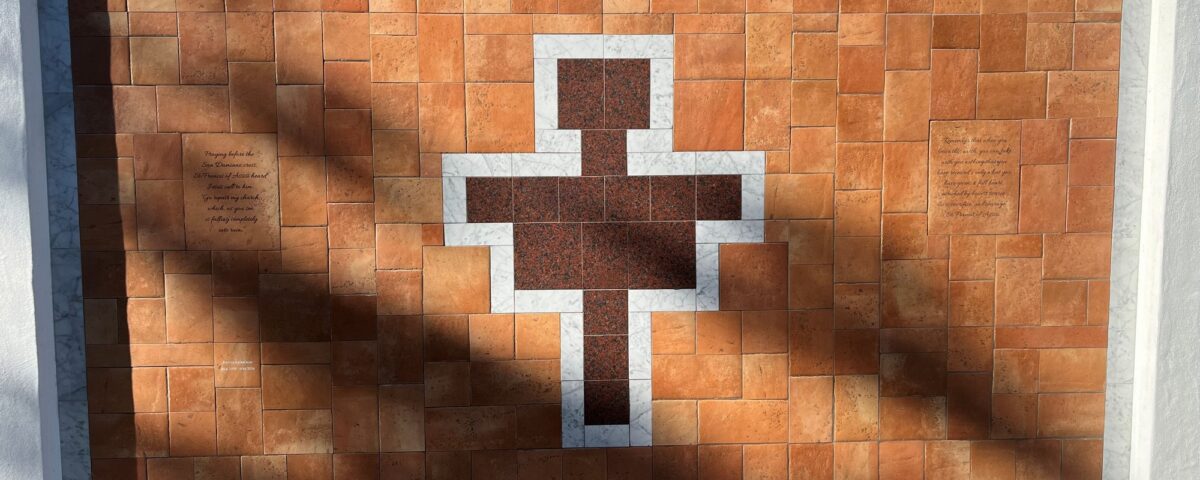
The San Damiano Memorial Wall faces our St. Matthew Mausoleum on the west wall of Mission San Luis Rey Cemetery, a serene and spiritual site open to all. It is a place to memorialize a deceased loved one.
The Wall not only honors the memory of loved ones, but offers a beautiful place for prayer and contemplation. Consider scheduling a guided tour of the Mission grounds, where you’ll also discover centuries of history, art, and Franciscan tradition.